

Financial disagreement is one of the leading causes of relationship conflict, and financial stress is consistently cited among the top predictors of relationship breakdown. This is not because couples are bad at relationships. It is because money is not just math - it is emotion, it is identity, it is the accumulated weight of every financial experience each partner had before they ever met each other.
At Adeline Financial and Career Coaching in Winnipeg, couples financial coaching is among the most meaningful work we do. We have sat with partners who have never, in years of living together, had a genuine conversation about their finances. Partners who discover in a coaching session that one of them is carrying secret debt. Partners who earn significantly different incomes and have never worked out a fair approach to shared expenses. Partners who have completely opposite instincts about money and have spent years in low-grade financial conflict without ever understanding why.
This guide is for all of them - and for any couple in Canada who wants to manage their money together more effectively, with less conflict and more genuine shared progress toward a life they are both excited about building.
Why do couples fight about money in Canada?
Couples fight about money because financial decisions are rarely just financial - they reflect deeply held values about security, freedom, generosity, ambition, and fairness that partners often hold very differently. Different money personalities (spender vs saver, risk-taker vs risk-avoider), different financial upbringings, different levels of financial transparency, and the absence of a shared financial plan are the most common structural drivers of money conflict in Canadian relationships. Research shows that couples who budget together, hold regular financial meetings, and have explicit agreements about shared money management report significantly lower financial conflict.
Why Couples Fight About Money - And Why It Is Rarely Really About Money
Most financial arguments between couples are not really about the specific transaction being argued about. They are about underlying values and needs that have never been made explicit. When one partner is frustrated that the other spent 200 dollars on something unplanned, the real argument is usually about security, about feeling consulted, about fairness, or about priorities.
When couples understand this - that money arguments are almost always values arguments in disguise - they can begin having the conversation that actually needs to happen.
The Four Money Personalities in Canadian Couples - Which Are You?
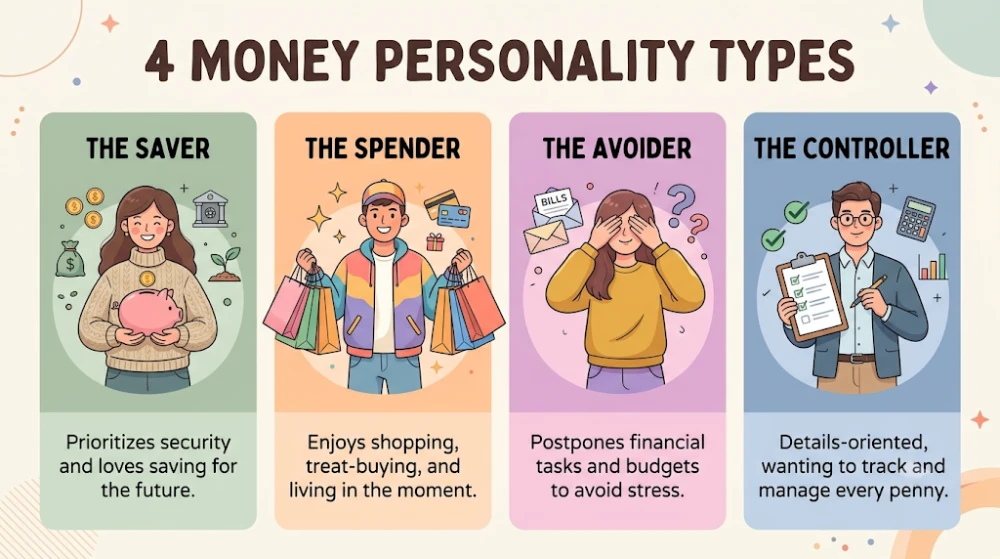
Understanding your own relationship with money, and your partner's, is the essential starting point for building a financial life together. Most people's money personality was formed long before they entered their current relationship. Here are the four most common money personality patterns we see in our couples coaching programs:
The Saver
Savers derive a sense of security from watching their account balances grow and experience genuine anxiety when money is spent on things that feel unnecessary. They tend to track expenses carefully, resist impulse purchases, and prioritize financial goals over present enjoyment. The saver's underlying need is security - and that need is entirely legitimate.
The Spender
Spenders derive pleasure and social connection from money spent in the present. They tend to be generous, spontaneous, and oriented toward experiences over savings. In a couple, a spender may be perceived by a saver partner as irresponsible. The spender's underlying need is often for enjoyment, connection, or a sense of abundance.
The Avoider
Avoiders have significant anxiety around money that manifests as avoidance behaviour - not opening bank statements, not tracking spending, putting off decisions. Avoidance is usually rooted in shame, fear, or a sense of powerlessness rather than indifference. This can leave the other partner carrying the full cognitive load.
The Controller
Controllers manage household finances unilaterally. In some cases, this reflects an efficiency orientation. In more problematic cases, financial control is a form of relationship power imbalance. Healthy couples financial management requires both partners to have full information, full access, and genuine input.
Financial Abuse in Relationships - Important Awareness
Financial abuse - controlling a partner's access to money, preventing them from working, monitoring all spending, or creating financial dependence - is a form of domestic abuse recognized in Canada. If these dynamics are present, please reach out to a qualified support service (e.g., Winnipeg Family Violence Prevention Centre). Coaching assumes a fundamentally equal partnership where both people have agency and safety.
The First Conversation: Your Money Story
Before any budget is built, the most valuable conversation a couple can have is about their money stories. Here are the questions we use with couples to open this conversation:
- What did money mean in your family growing up? Was it a source of stress, security, conflict, or abundance?
- What is your earliest specific memory involving money? What did it teach you?
- What are you most proud of financially? What are you most ashamed of?
- What does financial security mean to you? How much is enough?
- What do you believe about spending on experiences versus saving for the future?
- What is your instinctive emotional response when you check your bank balance?
How to Set Up Your Finances as a Couple - The Practical Options
There is no single correct way for Canadian couples to structure their finances together. The right system depends on your income structure, communication style, and values.
| System | Best For | Main Advantage | Main Challenge |
|---|---|---|---|
| Full Pooling | Similar incomes, high transparency | Maximum shared ownership | Requires constant communication |
| Proportional | Income disparity, equity focus | Fair relative contribution | More accounts to manage |
| Hybrid | Different life stages or histories | Maximum individual autonomy | Less financial transparency |
Option One - Full Financial Pooling: All income goes into shared accounts. All expenses are paid from shared accounts. It creates maximum transparency but requires high communication comfort.
Option Two - Proportional Contribution: Partners maintain personal accounts and contribute to a shared household account in proportion to their incomes. Widely regarded as the most equitable approach for couples with income disparity.
Option Three - Hybrid System: Combines a joint account for specific shared goals with full personal account independence for everything else. Excellent for couples navigating blended families or prior individual debt.
Building a Joint Budget That Both Partners Actually Follow
The most common joint budgeting failure is a budget that one partner builds and presents to the other. A joint budget must be built jointly. Here is how we guide couples:
- Establish your combined net monthly income (the starting number).
- List every shared household expense category based on actual spending.
- Identify and fund shared savings goals.
- Establish individual discretionary budgets for each partner (no-questions-asked money).
- Set up sinking funds for irregular shared expenses.
- Assign the budget to zero.
- Agree on a monthly review date.
The Monthly Money Meeting - The Habit That Changes Everything
The single most impactful financial habit we help couples establish is the monthly money meeting - a collaborative planning session held before the start of each new month.

- Review of last month: How did actual spending compare to the budget? No blame, just information.
- Upcoming irregular expenses: What is coming in the next 30 days?
- Progress on shared goals: Celebrate small milestones.
- Next month's budget: Build the plan for the coming month together.
- Open issues: Discuss any upcoming large purchases or changes in income.
Many couples in our coaching program tell us that this meeting was the single change that most transformed their financial relationship.
Navigating Income Disparity & Shared Goals
Income disparity is one of the most emotionally loaded dynamics in Canadian couples' finances. Proportional contribution is almost always fairer than equal contribution. Requiring a partner earning $35,000 to contribute the same dollar amount as a partner earning $95,000 creates real material hardship for the lower earner.
Furthermore, career breaks for caregiving (usually taken by women) should be explicitly planned for financially. The couple's retirement strategy must account for reduced RRSP contribution room. Financial independence and equity ensure both partners feel secure.
Aligning on What You Are Building Together
Stepping back from budget mechanics, ask the larger question: what are we actually building together? Naming your goals-whether it's saving for a first home, planning a sabbatical, or aligning on couples retirement planning-provides the most powerful motivation for financial discipline.
How Couples Financial Coaching Works at Adeline Financial
Couples financial coaching is not couples therapy, and it is not financial advising. It is a structured, practical coaching process. In our sessions, we create a neutral, judgement-free space where both partners can speak honestly. We help you design a system both partners genuinely believe in, and provide the ongoing accountability to make new habits stick.
Financial partnership is a skill built through intentional conversation. Whether you are combining finances or tackling shared debt (see how to get out of debt faster as a couple), we can help.
Stop Fighting About Money.
Book a free session to learn how our couples coaching can transform your financial relationship.
Book Your FREE Session




Ask the Experts