

Let us start with an unpleasant truth about Canadian cover letters: most of them are not read. Not because hiring managers are lazy or disrespectful, but because most cover letters give them no reason to read them.
They open with a generic declaration of interest in the position, proceed through a paragraph-by-paragraph summary of the resume they are attached to, and close with a polite request for an interview. They say nothing that could not be said about any other applicant. And so they are skimmed in fifteen seconds, filed, and forgotten.
Here is the other truth about Canadian cover letters in 2026/2027: a genuinely compelling cover letter remains one of the most powerful differentiators in a competitive job application. In a pile of fifty resumes where twenty candidates are technically qualified, the five candidates whose cover letters told a specific, relevant, and human story will almost always get the interview.
At Adeline Financial and Career Coaching in Winnipeg, cover letter coaching is part of every career coaching program we run. We have reviewed hundreds of Canadian cover letters, and the difference between ones that work and ones that do not is consistent, learnable, and almost always fixable. This guide gives you everything you need to write a cover letter that actually gets read - and actually gets you called.
Do You Actually Need a Cover Letter in Canada in 2026?
AEO Quick Answer: Do you need a cover letter for jobs in Canada?
Whether a cover letter is required for Canadian job applications depends on the employer and the application system. Many online job applications through Applicant Tracking Systems do not require one. However, when a cover letter is requested or when the application allows one, submitting a compelling, tailored cover letter significantly improves your chances. For professional, management, non-profit, government, and creative roles in Canada, a well-written cover letter remains a meaningful differentiator that demonstrates communication ability, research effort, and genuine interest in the specific role.
The short answer is: when in doubt, include one. The risk of not submitting a cover letter when one was expected is far higher than the risk of submitting one that was not strictly required. More practically, here is when a cover letter genuinely matters in the Canadian job market:
- When the job posting explicitly requests one - this is a compliance test as much as a communication exercise; failing to submit what was asked for signals poor attention to detail.
- When applying for professional or government roles - management, executive, non-profit, government, or creative hiring managers still expect and read them.
- When you have a career gap or career change - the cover letter is where that story gets told.
- When applying to a smaller organization - smaller employers in Winnipeg and across Canada consistently report that a personalized letter stands out.
- When reaching out proactively - an unsolicited application without a cover letter is just a resume; one with a letter is an expression of genuine interest.
When to Skip the Cover Letter
Skip the cover letter when: the application portal does not provide a field for one and explicitly says not to send additional documents; the job posting explicitly says no cover letter; you are applying to a very high-volume hourly or retail role where no cover letters are read; or when submitting a resume to a staffing agency for initial screening. In all other cases, including one is almost always the right call.
The Four Fundamental Mistakes That Sink Canadian Cover Letters
Before we get into how to write a great cover letter, it is worth understanding why most of them fail. The same four mistakes appear in the vast majority of cover letters we review in coaching sessions:
Mistake 1: Opening With "I"
"I am writing to express my interest..." is the weakest possible start. It makes you the subject of the letter when the employer and the role should be. A stronger opening puts the employer's challenge, the role's purpose, or your most relevant qualification front and centre.
Mistake 2: Summarizing Your Resume
A cover letter that restates the resume wastes the reader's time. The resume covers what you have done. The cover letter should explain why those things matter for this specific role at this specific organization.
Mistake 3: Generic Organization References
"I have long admired your company's commitment to excellence." Vague praise signals you didn't do your research. Specific, genuine organizational knowledge immediately distinguishes your letter.
Mistake 4: Focusing on What You Want
Hiring managers are not trying to find someone who would benefit from the role - they want someone who benefits their organization. Focus relentlessly on what you bring to them, not what they provide to you.

The Structure of a High-Performing Canadian Cover Letter
A cover letter that consistently performs well in the Canadian job market has a clear, readable structure with four distinct elements.
Your opening paragraph must capture attention and communicate your core value proposition. Do not start with "I". Lead with your most compelling credential, a specific connection to the organization, or a statement about the problem you solve.
WEAK:
"I am writing to apply for the Financial Analyst position at ABC Company as advertised on Indeed..."
STRONG:
"After five years building financial models for mid-market companies across Western Canada, I have learned that the difference between a good financial analysis and a useful one is the ability to translate data into decisions that non-financial stakeholders can act on. That skill is exactly what I understand ABC Company is looking for..."
Tell a story about your experience that is specifically relevant to this role. Follow a simple logic (the STAR method): here is something I have done, here is the result it produced, and here is why that matters for what you are trying to accomplish. If making a career change, address it directly here and reframe it as a strength.
Demonstrate specific, genuine knowledge of the organization and explain why that knowledge makes you want to work there in particular. Reference a recent announcement, a program they run, or a client you have a connection to.
Close confidently and briefly. Avoid weak, hedging closings like "I would appreciate the opportunity... if you feel it might be mutually beneficial." Instead use: "I am excited about the possibility of contributing to this work and would welcome a conversation about how my experience can support your team's goals."
Canadian Cover Letter Formatting and Length Rules
Canadian cover letter conventions are specific. Formatting errors signal a lack of professional polish:
- Length: One page maximum, always. Target 250 to 400 words.
- Format: Professional business letter format (your contact info at the top, date, hiring manager's details, formal salutation).
- Salutation: Address the hiring manager by name. Use "Dear Hiring Manager" only if the name is genuinely unavailable.
- Font: Same font as your resume (11 or 12 point). Calibri, Garamond, or Georgia are professional.
- File Format: Submit as a PDF to preserve formatting. Name it clearly:
First-Last-CoverLetter-OrganizationName.pdf. - Proofreading: Read it aloud. A typo in a professional application is often immediately disqualifying.
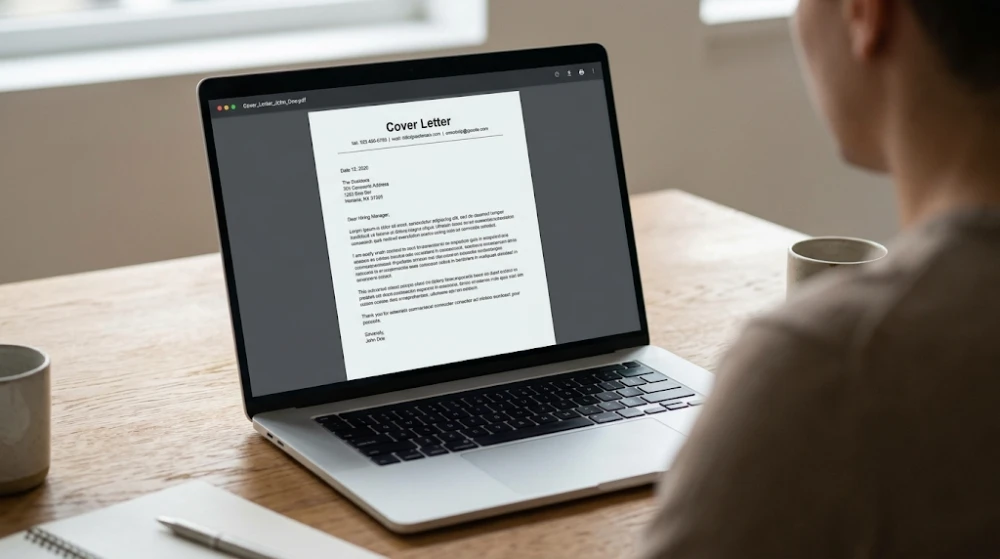
Cover Letter Templates for Different Canadian Career Situations
Template 1: Standard Professional Application
[Your Name] | [Email] | [Phone] | [LinkedIn URL]
[Date]
[Hiring Manager Name]
[Title]
[Organization Name]
[Address]
Dear [Name],
[Opening hook - your core value proposition or a specific connection to the role, 2-3 sentences. Do not start with I.]
[Body paragraph one - your most relevant experience, told as a brief story with a specific result. 3-4 sentences.]
[Body paragraph two - a second relevant strength or accomplishment, and specifically why this organization and this role. 3-4 sentences including your specific organizational knowledge.]
I am excited about the possibility of contributing to [organization name] and would welcome a conversation about how my experience supports your team's goals. I am available for an interview at your convenience and will follow up by email next week.
Warm regards,
[Your Name]
Template 2: Career Change Application
Dear [Name],
[Open by naming your core transferable strength - not your old career, but the skill that transfers directly to this new one. 2-3 sentences.]
[Body paragraph - describe 1-2 specific accomplishments from your previous career that are directly relevant to this new field. Explicitly name why these experiences transfer. 4-5 sentences.]
[Brief paragraph explaining your deliberate decision to make this career change, framed positively and forward-looking - what draws you to this field and this organization specifically. 2-3 sentences.]
I would welcome the opportunity to discuss how my background in [previous field] positions me to contribute to your team in ways that candidates coming directly from [new field] may not. I am available for a conversation at your convenience.
Warm regards,
[Your Name]
Template 3: New Graduate Application
Dear [Name],
[Open with your most impressive academic achievement, a specific project, a relevant placement, or a concise statement of the professional value you offer - not with 'I am a recent graduate'. 2-3 sentences.]
[Body paragraph - describe 1-2 specific experiences (academic projects, co-op, part-time work, volunteer work) that are directly relevant to this role, with specific outcomes. 4-5 sentences.]
[Organizational connection paragraph - specific knowledge of the organization and why you chose them deliberately. 2-3 sentences.]
I am eager to begin my career with an organization doing meaningful work in [field], and I believe [organization name] represents exactly the environment where I can contribute most effectively from day one. I would welcome the opportunity to discuss my application.
Warm regards,
[Your Name]
Tailoring Your Cover Letter for Every Application
The most common cover letter shortcut - writing one solid letter and submitting it unchanged to every job - is also the most common way to undermine an otherwise good application. Hiring managers and recruiters read many cover letters, and they recognize a generic letter immediately.
Effective tailoring does not mean rewriting your entire letter for every application. It means changing three specific elements:
- The opening paragraph - customize it to reference something specific about this organization or role.
- The organizational connection paragraph - this should always be specific to the individual employer.
- The specific accomplishment highlighted - choose the one or two most relevant experiences for this particular role.
Thirty minutes of targeted customization per application consistently outperforms the quantity strategy of sending fifty identical letters. Quality of application almost always beats quantity.
How Career Coaching Transforms Your Cover Letter and Application Strategy
Most people who struggle with cover letters are not struggling with writing ability - they are struggling with self-advocacy. With knowing how to talk about themselves confidently and specifically. With understanding which parts of their experience actually matter to employers.
These are exactly the things that career coaching addresses. At Adeline Financial and Career Coaching in Winnipeg, we review your cover letter with the perspective of someone who knows what hiring managers in your target field respond to. We help you identify the specific accomplishments that are most compelling, coach you on how to tell your professional story authentically, and work with you on the complete application package - resume, cover letter, LinkedIn profile, and interview preparation.

Your Next Job Is a Compelling Letter Away
The cover letter is not bureaucratic box-ticking. It is your first real conversation with a potential employer. Book your FREE Career Coaching Session today, and let's get your cover letter working for you.
Adeline Financial & Career Coaching | Winnipeg, MB





Ask the Experts