

There is a particular kind of financial stress that is unique to families, and if you have experienced it, you know it to a T. It is not simply the stress of not having enough money, though that is certainly part of it for many Canadian households. It is the stress of never quite knowing where the money went.
It is the stress of ending the month with less than expected with no clear explanation why. Of feeling like you're working harder every year, but somehow your financial situation never quite improves the way it should.
It is the experience of a household without a working financial system, and it is one of the most common financial realities in Canada today. According to research on Canadian household finances, a significant majority of Canadian families report living paycheque to paycheque at some point regardless of their income level. This is important because it indicates that it is not just about earning more-it is about having a clear, shared plan for the money that is coming in.
At Adeline Financial and Career Coaching in Winnipeg, we work with Canadian families at every income level. From single parents managing on a tight budget to dual-income professional households with growing children, the budgeting principles that work are the same at every income level and this guide provides you with all of them.
Why Family Budgeting is Unique
Quick Answer: How is budgeting different for a family in Canada?
Family budgeting in Canada includes considering multiple incomes, shared expenses, competing priorities, and different money personalities. Unlike individual budgeting, family budgets need to factor in rapidly changing child-related costs (childcare, education, clothing), variable seasonal expenses, and the complex emotional dynamics of aligning two adults with differing financial backgrounds. Families also carry unique long-term goals, such as saving for a home, children's post-secondary education through RESPs, and retirement.

The most common budgeting failure pattern we see in family coaching is the invisible budget-an arrangement where both partners sort of know what is coming in and what the big expenses are, but no one has a clear, written, shared picture of the complete financial landscape. In this scenario, financial decisions are made individually and reactively rather than collectively and intentionally. Money leaks from dozens of small channels that no one watches. When the bank balance runs low, stress is high because neither partner fully understands why.
The solution is a family budget that both partners build together, review together and maintain together. This guide will give you exactly how to build one.
Step One: Get the Complete Picture on One Page
Before building a family budget, both partners need a clear, honest picture of the complete financial landscape. This means bringing together every income source, every debt, every recurring expense, and every account and looking at this as a single, unified picture rather than as individual financial territories.
What to Gather:
- All income sources for both partners: Employment income (use net take-home pay, not gross salary), self-employment or freelance income, government benefits including the Canada Child Benefit, child support received, rental income, investment income, and any other regular cash inflow.
- All monthly expenses: Fixed expenses that never change (rent, mortgage, car payments, insurance premiums, subscriptions); variable expenses that change monthly (groceries, utilities, gasoline, clothing, dining out); and irregular expenses that arrive periodically (car maintenance, school supplies, property tax instalments).
- All debts: Every credit card, line of credit, car loan, student loan, and personal loan, with the current balance, interest rate, and minimum monthly payment for each.
- All savings and investment accounts: TFSA balances, RRSP balances, RESP contributions, savings accounts, and any investment portfolios.
- All financial goals: What you're working towards together-paying off debt, buying a home, saving for education, building an emergency fund, or planning a trip.
The Family Financial Meeting - Make it a Monthly Habit
Schedule a monthly budget meeting with your partner-a dedicated 30 to 45 minutes, ideally a few days before the month starts, where you build next month's budget together. No distractions, no phones. Review last month's results, discuss any upcoming irregular expenses, set the plan for next month, and check in on your financial goals. Couples that hold monthly budget meetings consistently report significantly less financial conflict and better financial outcomes.
Step Two: Build Your Family Zero-Based Budget
A family zero-based budget is the most effective budgeting method for Canadian families because it eliminates the invisible budget problem entirely. In a zero-based budget, you assign every dollar of your combined monthly income to a specific category before the month begins, until income minus all allocations equals zero. Nothing is unaccounted for; every dollar has a job.
Here is how to build your family zero-based budget step by step:
- Start with total net household income for the month. Include every income source for both partners. If income varies, use your lowest typical month as the baseline.
- List and fund your giving category first, if charitable giving is part of your family values. This ensures generosity is intentional rather than leftover.
- Fund your savings categories second-before any spending categories. Emergency fund contributions, RESP contributions, TFSA contributions, and any other savings goals. Paying yourself first is not a cliché, it's the only method that consistently works.
- Fund your fixed expenses-the obligations that are the same every month: mortgage or rent, car payments, insurance premiums, loan minimum payments, and regular subscription services.
- Fund your variable necessary expenses-groceries, utilities, gasoline, childcare, school-related costs, and medical expenses. (Understanding the difference between needs vs wants is crucial here).
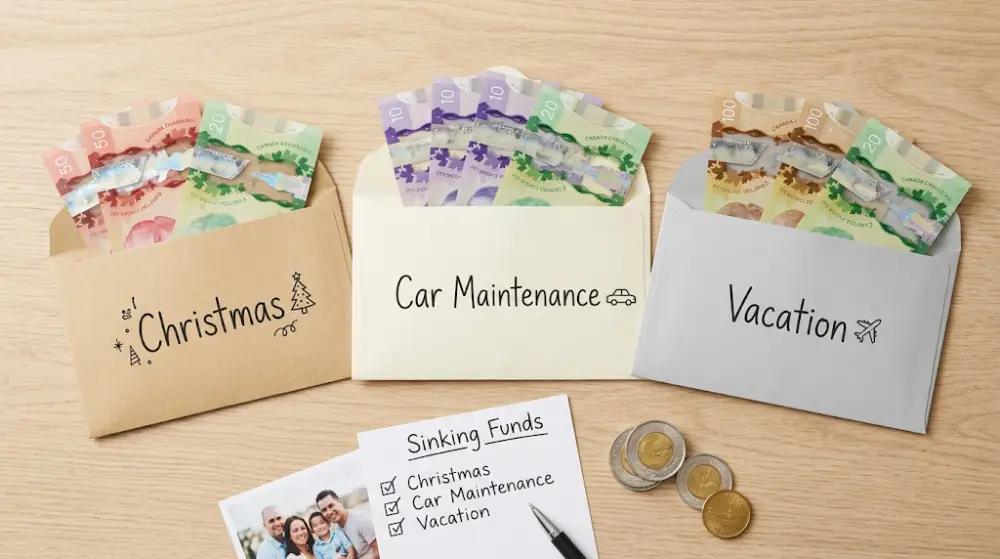
- Fund your irregular expense sinking funds-divide each annual irregular expense by 12 and set aside that amount every month in a labelled savings category. Christmas gifts, car maintenance, school supplies, summer camp, family vacation, and property tax all belong here.
- Fund your discretionary spending categories-dining out, entertainment, personal spending money for each partner, clothing, hobbies, and family activities. These are the lifestyle categories that make life enjoyable; they should be real and honest rather than aspirationally low.
- If total allocations exceed income, adjust discretionary categories first. If allocations are less than income, direct the surplus to your top financial priority.
The Key Budget Categories Every Canadian Family Needs
| Category | What Belongs Here | Typical % of Budget |
|---|---|---|
| Housing | Rent or mortgage, property tax, strata fees, home insurance, maintenance reserve | 25 - 35% |
| Food | Groceries, household supplies, dining out (keep separate from groceries) | 10 - 15% |
| Transportation | Car payment, insurance, fuel, transit pass, parking, maintenance sinking fund | 10 - 15% |
| Childcare & Education | Daycare, after-school programs, school supplies, activities, tutoring | 5 - 20% (varies) |
| Utilities | Electricity, heat, water, internet, mobile phones | 5 - 8% |
| Insurance & Medical | Life insurance, dental, vision, prescriptions not covered by benefits | 3 - 6% |
| Debt Repayment | All minimums plus extra snowball payment on priority debt | 5 - 15% |
| Savings | Emergency fund, TFSA, RRSP, RESP, sinking funds | 10 - 20% |
| Personal & Family | Clothing, haircuts, gifts, entertainment, family activities, subscriptions | 5 - 10% |
| Giving | Charitable donations, religious giving, community contributions | 0 - 10% |
The Sinking Fund - Your Secret Weapon Against Budget Chaos
The most common reason family budgets explode is irregular expenses that feel unexpected but are entirely predictable. Christmas comes every December. Back-to-school comes every September. Car insurance renews every year. The solution is a sinking fund-divide the total annual cost of every predictable irregular expense by 12 and set that amount aside monthly in a dedicated savings account or labelled budget category. When the expense arrives, the money is already there.

Budgeting for Children in Canada - The Costs Most Parents Underestimate
Children are the most significant financial variable in most Canadian family budgets-and the costs change dramatically as they grow. Here's what Canadian families typically spend at each stage, and how to budget for it:
Infant and Toddler Stage (Ages 0 to 4)
This is the highest-cost stage relative to income for many Canadian families, because childcare costs in this period can be extraordinary. Full-time licensed childcare in Canada costs anywhere from $800 to $2,500 per month depending on the province and the type of care, but federal and provincial childcare expansion programs have been reducing costs in many regions.
The Canada Child Benefit (CCB) provides meaningful financial support to families with children under 18-up to approximately $7,787 annually per child under six in 2026, phasing down with income. If you're not yet enrolled in the CCB, apply immediately through CRA My Account.
School Age (Ages 5 to 12)
School-age costs include school supplies and fees, clothing and shoes that children outgrow every year, extracurricular activities and sports which can become significant costs in Canadian communities where hockey, dance, gymnastics, and competitive sports are culturally prominent. Budget a specific monthly amount for each child's activities and hold that number firmly.
Teenager Stage (Ages 13 to 18)
Teenagers bring a different set of costs: significantly higher clothing and personal care budgets, driving lessons, increased technology and data costs, higher food costs, and the beginning of post-secondary planning costs. The RESP that was opened at birth should be well-established by this point.
The RESP - Start It at Birth and Never Skip a Contribution
The Registered Education Savings Plan is one of the best financial tools available to Canadian families. Contributions grow tax-sheltered, and the federal government adds a Canada Education Savings Grant (CESG) of 20% on the first $2,500 contributed per year-a free $500 per child per year, up to a lifetime CESG maximum of $7,200 per child.
How Canadian Families Can Find More Money in Their Existing Budget
One of the most consistent findings in our financial coaching work is that there is almost always more money available in the existing budget than the family believes. Implementing these smart Canadian saving tips can free up capital effortlessly:
- Subscription audit: The average household pays for 8 to 12 subscriptions. An audit consistently reveals $50 to $200 per month in services no longer valued or used.
- Grocery strategy: Meal planning, buying in bulk, and reducing food waste can reduce grocery costs by 15 to 30 percent without meaningful sacrifice.
- Insurance review: Comparing rates annually on home, auto, and life insurance through a broker can often save $500 to $1,500 annually.
- Cell phone plan review: Comparing current plans against MVNOs like Public Mobile, Koodo, or Fido at renewal routinely saves $20 to $50 per line per month.
- Dining and convenience food reduction: Eating out is typically the most elastic budget category. Reducing restaurant meals and batch cooking can save $300 to $600 per month.

Talking About Money as a Family - The Conversation Most Parents Avoid
One of the most underrated financial coaching conversations we have involves not the budget itself but the culture around money within the family. Most Canadian parents today grew up in households where money was not discussed openly with children. Research consistently shows that children who grow up in families where money is discussed openly, honestly, and age-appropriately become more financially capable and less financially anxious adults.
How Financial Coaching Helps Canadian Families Get on the Same Page
The biggest challenge in family budgeting is almost never mathematical. It is interpersonal. Two people with different financial backgrounds, different money personalities, and potentially different values trying to manage a shared financial life.
At Adeline Financial and Career Coaching in Winnipeg, we offer financial coaching programs to help families build both the financial plan and the communication skills that make it sustainable. We help partners understand their own money stories, build a budget that honours both partners' priorities, and set shared financial goals both partners are genuinely motivated by.
Our coaching clients consistently tell us (read what our coaching clients say) that the financial plan is valuable, but the shift in how they talk about money together is what actually changes their financial lives.
Your Family Deserves a Financial Plan That Actually Works
The families we work with at Adeline Financial do not struggle financially because they don't care about money or don't work hard enough. They struggle because no one ever taught them how to manage money together-how to build a plan that both partners understand and believe in.
A working family budget is not a restriction on your life. It is the foundation that makes the life you actually want possible. It is what turns financial stress into financial progress, and financial progress, over time, into genuine financial freedom.
Ready to Take Control of Your Family's Finances?
If you still have common financial coaching questions, our team is here to help clarify the process for you. Stop guessing with your money and build a robust financial future today.
Book Your FREE Family Financial Coaching Session Today
Helpful Related Resources from Adeline Financial:
- Zero-Based Budgeting Step-by-Step
- Build Your Family Emergency Fund
- Understand Needs vs Wants
- Financial Coaching Programs in Winnipeg
- How to Get Out of Debt as a Family
- Smart Canadian Saving Tips
FAQs
A realistic family budget in Canada depends heavily on your city, household size, income, and life stage. A family of four in Winnipeg might have monthly essential costs of approximately 3,500 to 5,500 dollars depending on housing costs, childcare situation, and vehicle needs. As a general framework, total housing costs should be below 35 percent of gross income, all debt payments including housing should be below 44 percent of gross income under federal mortgage qualification guidelines, and the household should be saving at least 10 percent of net income toward emergency fund, retirement, and education goals combined. A financial coach can build a realistic budget specific to your actual numbers.
Income disparity within a partnership is more common than most people realize and does not need to be a source of power imbalance or resentment - but it does need to be handled intentionally. Common approaches include pooling all income into a joint account from which all family expenses and savings are funded; a proportional contribution system where each partner contributes a percentage of their income rather than a fixed dollar amount to shared expenses; or a hybrid system with a joint account for shared expenses and individual accounts for personal spending. Whatever system you choose, both partners should have equal access to the full financial picture and equal input into financial decisions. A financial coach can help you design and implement the system that fits your specific situation and values.
Starting a family budget while carrying debt is not only possible but essential. The budget is precisely the tool that creates the space to make progress on the debt. Begin by creating a complete picture of your income, all debts, and all expenses. Build a zero-based budget that covers all essential expenses and debt minimum payments first. Then identify discretionary spending that can be reduced temporarily to create an extra monthly amount to direct toward the priority debt using the debt snowball or debt avalanche method. Even a small extra payment accelerates payoff significantly over time. A financial coach helps you sequence these priorities and sustain the plan through the months it takes to produce visible results.
No. The Canada Child Benefit (CCB) is a tax-free monthly payment - it is not included in your taxable income and does not need to be reported on your T1 tax return. However, your CCB entitlement is calculated based on your family's Adjusted Family Net Income from the previous tax year, which is why filing your taxes on time every year is important even if you owe no tax. Missing a tax filing can pause or reduce your CCB payments.





Ask the Experts