

This article describes the role of a financial coach and a financial advisor and considers how each is rewarded and governed in Canada. Usually, someone will first require the services of a financial coach to build strong day-to-day cash flow habits and then later work with a financial advisor to grow their investments.
As financial coaches, we at Adeline Financial and Career Coaching in Winnipeg recognise both when coaching is and is not suitable. Our aspiration is to ensure that you receive appropriate assistance at the correct time.
What is a Financial Coach?
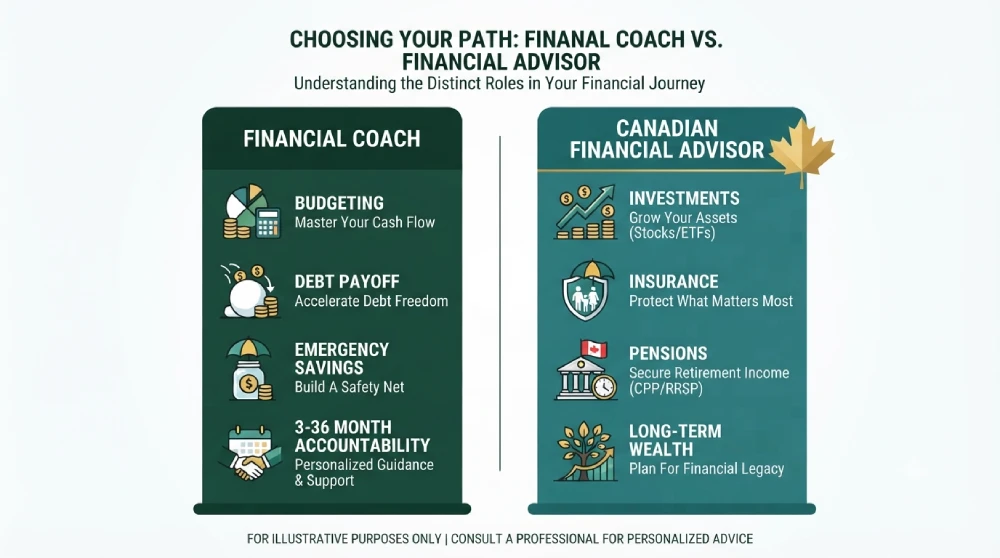
In short: Financial coaches work with individuals and couples to encourage healthy money behaviours and develop a practical financial strategy. Topics commonly covered include budgeting, repaying debt, creating an emergency fund, improving money habits and defining clear goals. Unlike financial advisors, financial coaches do not promote or manage investments-their expertise is behaviour, strategy and education.
Financial coaches investigate how money is both received and spent and how debt is handled. They then assess whether your daily financial behaviours are aligned with your short- and medium-term goals. Coaching is a supportive, non-judgmental and active process where regular meetings occur to monitor progress, address obstacles and maintain accountability.
Coaching can be especially helpful where an individual lacks not just financial information, but also persistence, clear goal definition and confidence in managing day-to-day cash flow.
What is a Canadian Financial Advisor?
In short: Canadian financial advisors are professionals who are authorised to advise on-and often promote-financial goods such as mutual funds, insurance policies and investment vehicles. Advisors are governed by either provincial insurance or securities authorities depending on the financial products they offer.
Whilst advisors commonly specialise in investments, pensions and insurance, many are authorised to promote these and other financial products. Some also hold specialist credentials (for example, Certified Financial Planner or CFP®). Because the terminology ‘financial advisor’ and ‘financial planner’ is widely used across Canada, there is considerable variation in the authorisations permitted under each title. Therefore, it is always wise to ask an advisor directly what they are licensed to do, which regulatory authority governs them and how they are compensated.
Financial Coach vs. Financial Advisor
Use the comparison table below to see how a financial coach and a regulated Canadian financial advisor differ across expertise, compensation, governance and timeline:
| Comparison Factor | Financial Coach | Financial Advisor (Canada) |
|---|---|---|
| Areas of Expertise | Money behaviours, zero-based budgeting, debt repayment, emergency funds and goal clarity. | Investments, pensions, insurance, tax-advantaged accounts and wealth accumulation. |
| Most Suitable For | Individuals or couples experiencing cash-flow stress, consumer debt, or inconsistent budgeting habits. | Individuals with steady cash flow, surplus money to invest and decisions regarding financial products. |
| Promotes Financial Goods? | No-unbiased guidance with zero product sales. | Often, or is compensated in relation to financial products recommended. |
| Manages Investments? | No. | Often, if licensed and authorised to do so. |
| Reward Structure | Transparent fixed charges for coaching sessions or structured programmes. | Percentage of assets under management (AUM), product commissions or fee-based planning charges. |
| Governance | Coaching is typically not statutorily regulated; however, coaches should hold credible training and ethical standards. | Authorised and governed by provincial insurance and/or securities authorities (e.g., CIRO, provincial regulators). |
| Nature of Working Relationship | Ongoing, collaborative and focused on hands-on behavioural accountability. | Periodic reviews focused on managing an investment portfolio and product suitability. |
| Typical Timescale | Generally relates to the next 3-36 months. | Usually relates to long-term investment and retirement provision (10-30+ years). |
When Do I Need Which?
Choosing the right professional comes down to where you currently stand on your financial journey:
- You are unaware of where your money is going each month.
- You carry credit card, line of credit, or other consumer debt-explore how a financial coach in Winnipeg can assist with debt.
- You do not have-or have limited-savings set aside; learn the steps to creating an emergency fund in Canada.
- You have tried to create a budget before, but struggled to stick with it without a practical system like zero-based budgeting for Canadians.
- You and your partner disagree about money or lack a shared household strategy.
- You want ongoing accountability and encouragement alongside practical education.
- You are preparing for a major life milestone (such as buying your first home) and want your finances organized first.
- You have effectively managed your consumer debt and hold a solid emergency fund.
- You have surplus money to invest and want help choosing between registered accounts-see our comparison of TFSA and RRSP accounts in Canada.
- You are 10-15 years away from retirement and want a strategy to generate retirement income; read our overview on retirement planning for Canadians.
- You have complex financial needs (such as running a corporation, estate planning or managing substantial assets).
- You would like your investment portfolio professionally selected and managed.
You May Require Both-In This Order
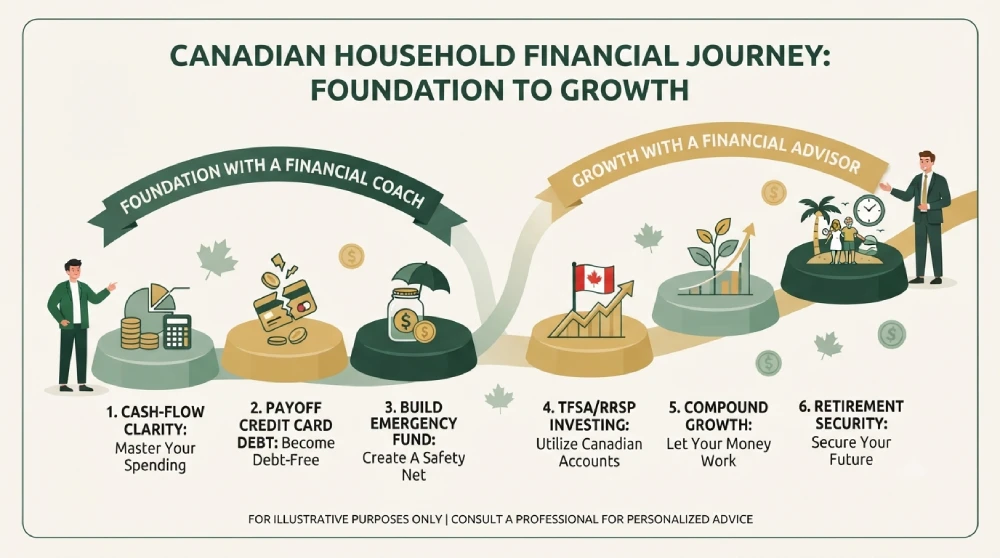
Many Canadians achieve the best results by initially engaging a financial coach. Coaching enables you to organise your cash flow, repay high-interest debt and establish an emergency fund alongside sustainable spending habits. Once a solid financial base is in place, a financial advisor can help invest your surplus funds effectively. Moreover, when your day-to-day money behaviours are strong, you are far more likely to continue investing consistently and with discipline.
Basic Guidance: Which Step Should You Take Today?
If you predominantly struggle with a feeling of lack of control in relation to your day-to-day money, seek the services of a financial coach. Should you predominantly experience difficulty in knowing how to invest surplus money, engage a financial advisor. If you are uncertain which situation applies to you, a free initial meeting with a financial coach can clarify your best next step.
How Much Do They Cost? (In Canada)
Costs can differ greatly across Canada depending on the service model and scope. Below are general indications only:
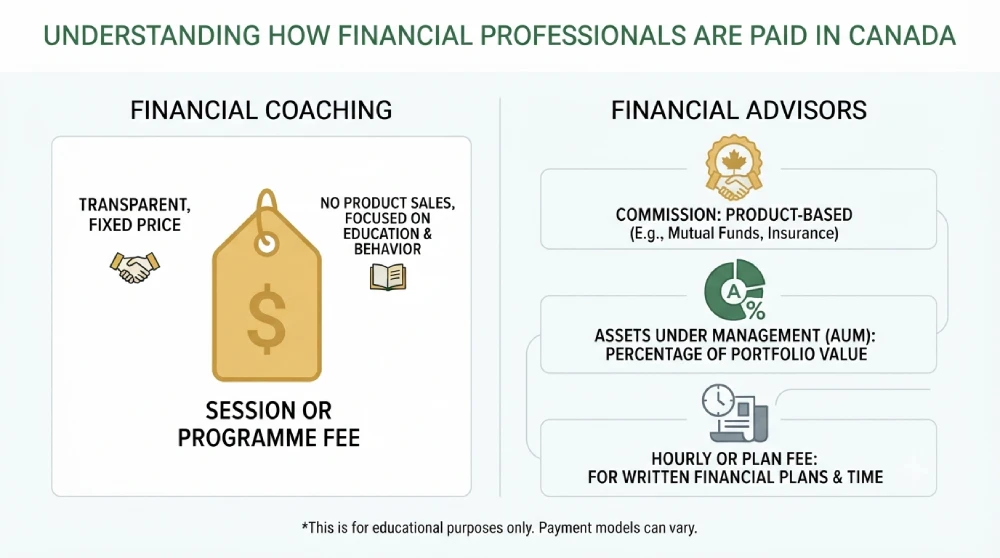
- Financial Coaching Fees: Most commonly offered via transparent fixed charges per session, for a bundle of sessions, or for a structured multi-month programme. You know the exact cost upfront with zero hidden product commissions.
- Financial Advisor Compensation: Advisors may be compensated through commissions or trailer fees on financial products promoted, through an annual percentage of assets under management (AUM) or via hourly or fixed fees for standalone financial plans. Because different reward methods can create different incentives, it is essential to understand fully how an advisor is paid.
In every case, ask how the professional is rewarded, establish the total annual cost in dollars and verify whether an advisor receives additional incentives for recommending specific financial products.
7 Key Questions to Ask Potential Financial Professionals
Before hiring either a financial coach or a financial advisor in Canada, ask these seven due-diligence questions:
- What training, qualifications and/or authorisations do you hold-and by which regulatory authority are you governed?
- How are you compensated and what will my total annual cost be?
- Do you promote, sell or receive financial rewards in relation to any specific financial products?
- Could you outline both the structure and expected duration of our working relationship?
- Can you share examples of typical outcomes for clients in my situation, as well as verified client testimonials or references?
- What happens if my income, goals or personal circumstances change during our working relationship?
- Do you offer a free initial consultation to assess compatibility before I commit?
Credit Counsellors, Accountants and Mortgage Brokers
Alongside coaches and advisors, three other specialists play important roles in Canada’s financial ecosystem:
Credit Counsellors
Usually operating through non-profit agencies, credit counsellors advise individuals facing severe debt insolvency and help negotiate formal Debt Management Plans with creditors.
Accountants (CPAs)
Accountants specialise in personal and corporate tax preparation, tax compliance, bookkeeping and tax-minimization strategies.
Mortgage Brokers
Mortgage brokers compare residential and commercial mortgage lenders to arrange home financing and renewals.
Financial coaches frequently collaborate alongside these professionals-helping you organize your budget, credit habits and documentation so you get maximum value when meeting with an accountant, mortgage broker or investment advisor.
How Adeline Financial Coaching Operates
At Adeline Financial and Career Coaching, we begin by analysing your complete financial picture-including income, debt obligations and spending patterns-and co-create a realistic plan built around zero-based budgeting, structured debt repayment and emergency fund creation.
Regular coaching sessions then take place to track progress, adjust your plan as life evolves and sustain positive accountability. Because we never promote or sell financial products, our guidance remains 100% focused on your habits, clarity and long-term goals. Explore our structured financial coaching programmes in Winnipeg or browse our frequently asked questions to see how sessions work.
Once your financial foundations are firmly established and you are ready for regulated investment or insurance advice, we gladly support you in evaluating your options and connecting with appropriately qualified professionals.

Educational Disclaimer: This article is provided for general educational purposes in Canada and does not constitute regulated investment, tax, or legal advice. Always verify provincial licensing and regulatory standing before engaging an investment or insurance advisor.





Ask the Experts