

Key Takeaways: Mastering Canadian Job Interviews
- The Real Purpose: An interview is simply a two-way conversation to prove you can do the job and fit the team.
- Preparation > Talent: Failure usually stems from lack of research and rambling answers, not lack of intelligence.
- The STAR Framework: Canadian employers heavily favor behavioral questions. Structure your stories using Situation, Task, Action, and Result.
- Virtual Readiness: Master eye contact, lighting, and tech checks for online interviews.
Job interviews are a peculiar phenomenon. Imagine months or even years of hard work, skill development, and career growth being boiled down to a 45-minute interview with a stranger in a situation where your adrenaline rush could potentially jeopardize your emotional stability.
No wonder most Canadians find job interviews terrifying. Now imagine if I told you that a job interview is not meant to judge your competency or intelligence. A job interview is actually a conversation where you seek to answer two core questions for the interviewer:
- Can this candidate do the job?
- Will this candidate fit with our team?
All you have to do is convince them of those two things with your answers. Such a perspective turns job interviews into a preparable experience instead of a scary one. Preparation is a skill that you hone, and in Winnipeg, one of the highest-leverage areas of preparation for a career coaching client is preparing for job interviews.
This guide is a direct result of the interview preparation process we use with our Canadian clients at Adeline Financial and Career Coaching. Below, we share our expertise on how to prepare for a job interview in Canada with confidence and skill in every aspect.
Why Do People Fail Job Interviews in Canada?
The most common reasons why Canadians fail job interviews are a lack of preparation, inability to communicate experience with specific examples, failure to research the employer, disorganization when answering questions, and inability to ask thoughtful questions during the interview. People who prepare for job interviews tend to perform significantly better even when they have less natural talent than their competition, including senior-level candidates.
Why Preparation – And Not Natural Talent – Determines Interview Success
The most common interview failure triggers for our career coaching clients before they start working with us include:
- Generic responses: Clichéd answers such as "I am a hard worker" or "I am passionate about this industry" fail to stand out. Showcasing specific achievements with concrete metrics is far more effective.
- Lack of research: Interviewers know within the first five minutes whether a candidate has done their homework.
- Disorganization: Rambling answers force the interviewer to do extra mental work to extract value from your monologues. Concise, structured responses win.
- Lack of structure when talking about yourself: Most job interviews start with an opening question about your background. This is your chance to hook the interviewer.
- No questions prepared for the interviewer: Stating that you have no questions shows a clear lack of preparation and interest in the position.
- Bragging about salary prematurely: Asking about money before proving your value significantly reduces your negotiation power.
Phase One – Research: Position Yourself Better Than Anyone Else
Organizational research is the most critical preparatory step. Candidates who do their homework always leave a superior impression compared to those who rely solely on natural talent. Research serves as the backbone for structuring your answers, coming up with questions, and supporting your claims.
Research the Organization
Use the following resources to identify the company's pain points and core values:
- Website: Study the About Us section, mission statement, and Leadership Team profiles.
- LinkedIn: Follow the company page for recent developments. If you know your interviewer's name, review their LinkedIn profile to understand their background.
- Glassdoor: Get authentic insights into company culture, employee reviews, and interview questions previously asked.
- Google News: Search the company name and filter by the past year to uncover recent press releases, product launches, or major projects.
- Reports: For government agencies and public businesses, review annual reports and impact reports to identify key organizational goals.
Research the Position
Study the job description carefully. Identify the top 3 to 5 requirements and pain points the employer wants to solve. Match these requirements to specific achievements from your past career experience—these will form the foundation of your interview stories.
What is the STAR Method for Job Interviews?
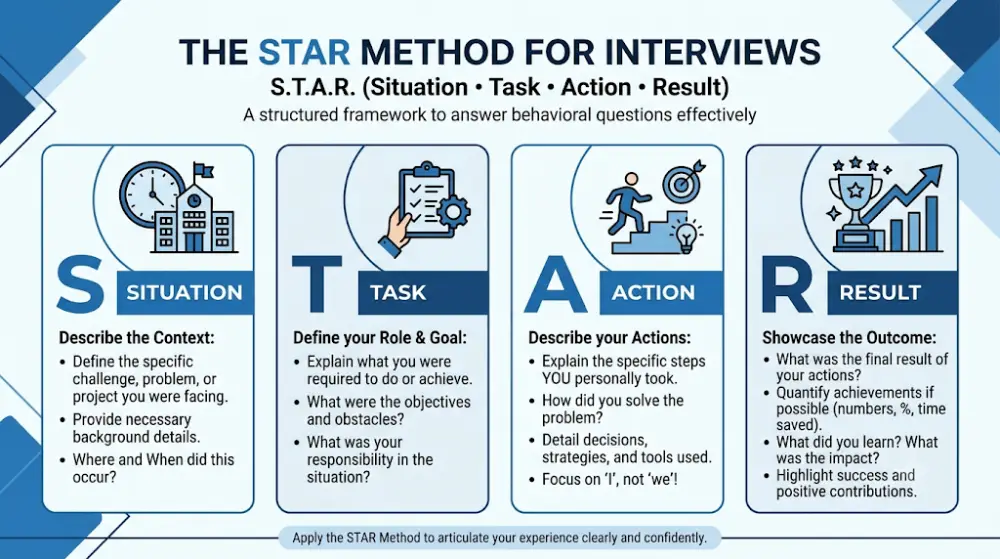
The STAR method is a structured technique for answering behavioral interview questions. STAR is an acronym for Situation, Task, Action, and Result. It is designed for questions that begin with "Tell me about a time when..." or "Give me an example of..." to evaluate a candidate's future performance based on past concrete evidence.
Phase Two – STAR Method: The Most Powerful Interview Tool
Behavioral questions are exceptionally common in the Canadian job market. Instead of making unsubstantiated claims about your abilities, the STAR method helps you structure clear, evidence-based answers.
STAR Method Example: Managing a Project Under Pressure
Question: "Tell me about a time when you had to manage a large project through an unexpected obstacle."
Situation: There was a project I was managing to onboard a new client onto our software. Three weeks before launch, our main vendor informed us of significant delays that would push the go-live date past our contractual deadline.
Task: As the project coordinator, I was responsible for timely completion and managing client expectations. Contractual obligations had to be met to avoid financial penalties or contract non-renewal.
Action: I organized an emergency meeting with my team to map out a manual software bridge contingency plan. I delegated tasks immediately and met with the client to proactively explain the situation and our mitigation strategy. Additionally, I negotiated a service credit with the vendor for the disruption.
Result: We launched on time using the manual bridge process. The client was so impressed by our transparency and professionalism that they commended our team, and the vendor's service credit offset nearly two months of third-party operational costs.
We recommend preparing 8 to 12 STAR stories covering key competency areas: leadership, conflict resolution, problem-solving, learning from failure, collaboration, managing priorities, adapting to change, and delivering results.
Phase Three – Common Canadian Job Interview Questions & Approaches
The Opening Questions
Tell me about yourself.
This is your 90-second professional summary. State your current role, summarize your professional journey in one sentence, explain the unique value you offer, and share why you are genuinely excited about this specific opportunity.
Why do you want to work here?
Demonstrate your company research. Mention a specific initiative, value, or project that resonated with you. Avoid generic praise.
What is your greatest weakness?
Select a real, non-critical professional weakness. Explain how it impacted you and the concrete steps you took to overcome it (e.g., struggling with delegation early in a leadership role and adopting project management tools to build trust).
Experience and Competency Questions
- Greatest professional accomplishment: Use a STAR story highlighting measurable impact and metrics.
- Describe a time you failed: Focus heavily on your self-reflection, accountability, and the valuable lessons learned.
- Prioritizing multiple deadlines: Explain your organizational methodology (e.g., Eisenhower Matrix, project software) with a real-life example.
- Influencing without authority: Showcase your collaboration, active listening, and persuasion skills.
- Adapting to significant change: Highlight your agility, positive attitude, and resilience during transitional periods.
Culture and Motivation Questions
- Working style: Use specific examples illustrating how you communicate, solve problems, and collaborate with team members.
- Five-year plan: Align your personal career growth realistically with the growth opportunities available at the hiring company.
- Why are you leaving your current job? Always frame your answer positively around seeking new growth opportunities rather than criticizing past employers.
Phase Four – Questions to Ask the Interviewer: Your Secret Weapon
When the interviewer asks, "Do you have any questions for us?", declining to ask questions signals a lack of enthusiasm. Asking insightful questions positions you as a serious, top-tier professional.
High-Impact Questions to Ask:
- "What does success in this role look like in the first 90 days?"
- "What are the most significant challenges the person in this position will face?"
- "How would you describe the day-to-day culture of this team?"
- "What do you enjoy most about working here?"
- "What are the growth and development opportunities for someone in this role?"
- "What is your typical timeline for making a hiring decision?"
Red Flags to Avoid: Do not ask about salary, vacation time, or benefits in the first interview unless brought up by the employer. Avoid asking basic questions that are easily answered on the company's homepage.

Phase Five - Virtual Interview Best Practices
Video interviews via Zoom, Microsoft Teams, or Google Meet are now standard practice across Canada. Elevate your virtual presentation with these technical best practices:
- Tech Check: Test your camera, microphone, and internet connection 24 hours prior.
- Lighting & Background: Ensure soft, front-facing light on your face. Avoid sitting in front of a bright window (backlighting).
- Camera Angle: Elevate your laptop so the camera is at eye level.
- Eye Contact: Look directly into the camera lens when speaking rather than at the screen.
- Cheat Sheets: Position digital prompts or your resume near your camera line of sight on a second screen.
Phase Six – The Follow-Up Thank-You Note
Sending a personalized thank-you note within 24 hours reinforces your interest, demonstrates professional courtesy, and keeps you top-of-mind.
Sample Follow-Up Email Template
SUBJECT: Thank You – [Your Name] – [Job Title] Interview
Dear [Interviewer’s Name],
Thank you for your time today. I really enjoyed our conversation regarding the [Job Title] position at [Company Name]. My interest in the role has grown after learning more about [Specific Project/Goal discussed].
Our discussion about [Specific Topic] reassured me that my background in [Relevant Skill/Experience] will allow me to contribute directly to [Specific Goal]. Please let me know if you need any additional details. I look forward to hearing about the next steps.
Warm regards,
[Your Name]
[Phone Number] | [LinkedIn Profile]
How Career Coaching Builds True Interview Confidence
Reading about interview preparation is helpful, but practicing your answers out loud is where real transformation occurs. Working with a professional coach gives you realistic practice, constructive critique, and tailored strategies.
At Adeline’s Career Coaching Approach, our Winnipeg clients undergo comprehensive job description breakdowns, custom STAR story crafting, and live mock interviews with personalized feedback.
Have questions about how the coaching process works? Check out our Career Coaching FAQs to learn more.





Ask the Experts