
Every year, many Canadians face a key financial decision: whether to invest in a TFSA or an RRSP. While it may seem simple, the right choice depends on your income, tax situation, financial goals, and when you plan to use your money.
Understanding how each account works makes it easier to choose the right option. At Adeline Financial & Career Coaching, experts help individuals build strategies that align with their financial goals and lifestyle.
A Tax-Free Savings Account (TFSA) allows Canadians aged 18 and older to invest money after tax. The key benefit is that all investment growth and withdrawals are completely tax-free.
Explore financial coaching programs to learn how to maximize your TFSA benefits.
A Registered Retirement Savings Plan (RRSP) allows you to contribute pre-tax income, reducing your taxable income today. Investments grow tax-deferred, but withdrawals are taxed later as income.
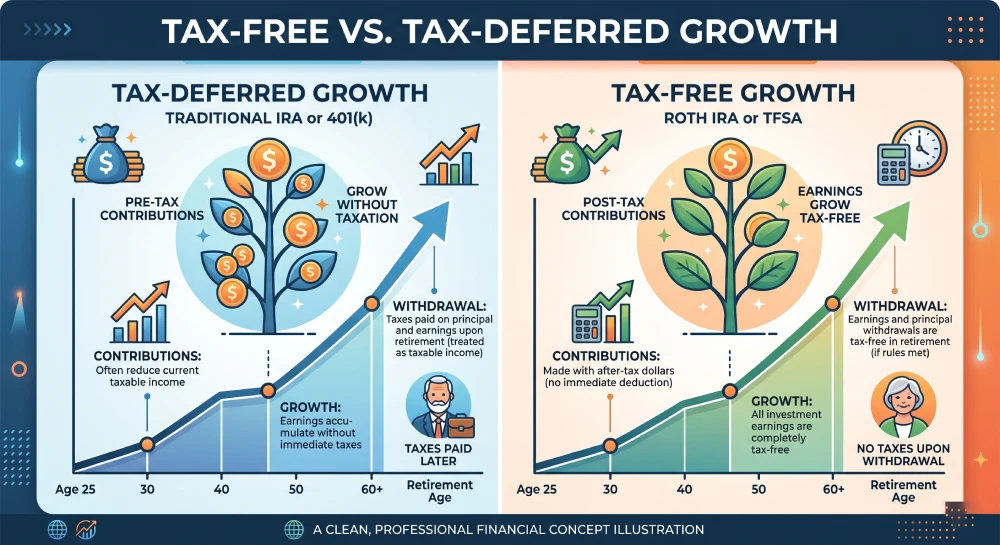
| Feature | TFSA | RRSP |
|---|---|---|
| Tax on Contributions | After-tax | Tax-deductible |
| Tax on Growth | Tax-free | Tax-deferred |
| Withdrawals | Tax-free | Taxed as income |
| Flexibility | High | Restricted |
| Best For | Flexibility & short-term goals | Retirement & high-income earners |

Many Canadians benefit from using both accounts strategically. For example:
Learn how to build a personalized strategy with TFSA and RRSP planning support.
Choosing between TFSA and RRSP depends on your income, tax bracket, and goals. A personalized plan ensures you maximize benefits and avoid costly mistakes.
At Adeline Financial, coaching is tailored to your situation, helping you make informed decisions based on real financial data.
Start your journey with a free financial coaching consultation and take control of your financial future.
Yes, absolutely. There is no rule preventing you from holding both accounts simultaneously. In fact, using both strategically is what most Canadian financial coaches recommend for long-term wealth building. The two accounts complement each other perfectly — the RRSP provides a tax deduction now, while the TFSA provides completely tax-free growth and withdrawals later.
TFSA over-contributions are penalized at one percent per month on the excess amount until it is withdrawn. RRSP over-contributions above $2,000 are also subject to a one percent monthly penalty. It is important to track your contribution room carefully. CRA's My Account portal shows your current TFSA and RRSP room at any time.
Yes, the annual TFSA dollar limit applies equally to all eligible Canadians (age 18+, resident of Canada). However, your total available contribution room may differ from someone else's depending on when you turned 18, whether you were a Canadian resident in previous years, and whether you made withdrawals in previous years (which restore contribution room the following year).
Newcomers to Canada begin accumulating TFSA contribution room from the year they become a Canadian resident and are age 18 or older. TFSA is generally recommended first for newcomers because it does not require Canadian employment income history, withdrawals are completely flexible, and it can be used to build an emergency fund while becoming established. RRSP becomes more valuable once income — and therefore the tax deduction benefit — is established.